|
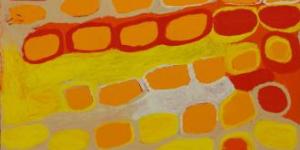
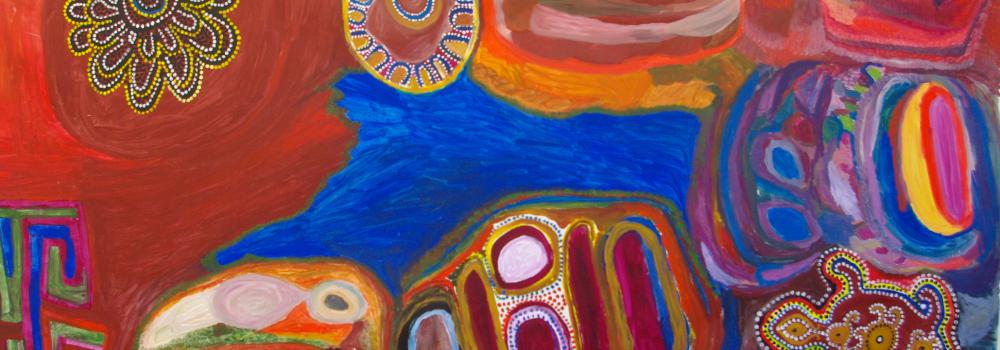
Mangkaja artists have been producing collaborative canvases since their first show at Tandanya in Adelaide in 1991. There they worked on two banners to advertise their exhibition and this has become habitual, with the exhibiting artists often working together in galleries over the opening days of their exhibitions. NGURRARA CANVASES MARTUWARRA AND JILA Fitzroy Crossing is located on Bunuba and Gooniyandi country. Janet Williams recalls that her father and several other Bunuba elders were asked by Walmajarri and Wangkajunga people if they could cross the river, onto their land. She says that her father welcomed them however the longing for desert lands that the old people felt is clearly expressed by a Walmajarri man, Pompey Siddon as he stated, only months before he died in 1994: In
Fitzroy Crossing we’re sitting down now in this little murnturu
(island). This is Bunuba country. They are the bosses for this country,
for this land. We came in from Cherrabun Station. Before that I was in
the bush. With such a strong demarcation between the river and desert, it is not surprising that these artists have not worked together in the past. The cohesion amongst the individuals of what is potentially a disparate group is played out in the strength of the Martuwarra and Jila painting— in the juxtaposition of image, colour and form. This canvas reveals a significant collaboration and Daisy Andrews acknowledges this when commenting about the work: It’s really good now how we can all sit down and work together, it’s really good, river and desert together, whole lot. |
|
|||
POTTERY CERAMICS Word spread about the workshops and communities were asking for Maureen and Lurgo to make return visits. The project gathered momentum with two major outcomes. The first was a group exhibition titled ‘Story Boards’ at the Fremantle Art Centre, to coincide with the Ninth Annual National Ceramics Conference. The Story Boards project was designed to introduce a broad range of people to clay. Artists from the four main language group serviced by the centre, Bunuba, Gooniyandi, Walmajarri and Wangkajunga have all been involved in producing tiles for the show. Tiles were selected as a most immediate and portable way in which to work and the latter feature was essential as Mangkaja services a number of communities which are sparsely spread throughout the Fitzroy Valley. To access these places, bags of clay have been piled into the Mangkaja vehicle or the local charter plane with visits to around ten communities over several months. The average time spent in each place has been three days. The tiles have been hand rolled. In most cases they are loosely square although some are freely formed oval shapes. The markings range from carefully sculpted relief carving to fresh, simple drawings made with satay sticks and lino carving tools. They are finished with a terrasigilata developed from pindan, the characteristic red soil of the Kimberley region. They are once fired in an oxidation atmosphere. The second stage of the project was the placement of over seven hundred tiles on the terraced step adjoining the supermarket carpark. It is a very popular meeting place and the tiles are an interesting feature for both locals and travellers. |
![]() The tiled terrace outside Mangkaja Arts |
|||
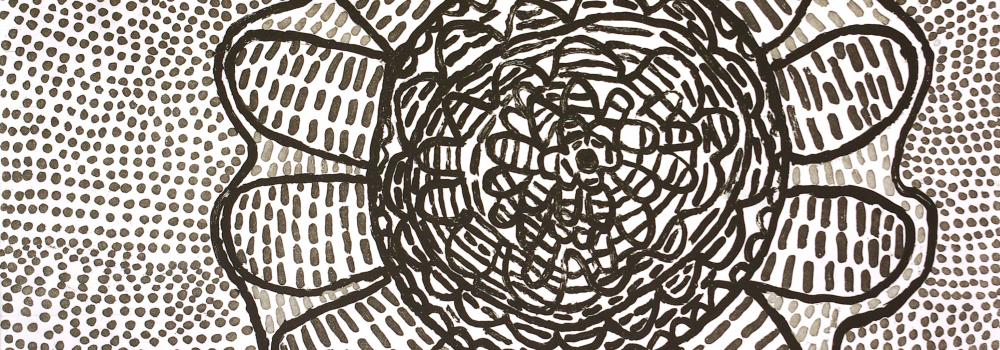
PRINTMAKING 1994 when Gill Weaver from the Teenage Roadshow, visited Mangkaja Arts. He asked for suggestions for a place where Melbourne printmaker, Martin King, could run some workshops as part of the Roadshow program. Having recently renovated the Old Mangkaja workspace the timing was perfect. Martin arrived mid year after a three week workshop in Kalumburu and set up in Fitzroy Crossing for ten days of etching and lino printing. The artists produced a wide variety of images in the first workshop and a strong working relationship developed with Martin King and the Australian Print Workshop in Melbourne. After subsequent workshops in Melbourne and Fitzroy Crossing a number of artists have continued to produce prints, most notably Ngarralja Tommy May, Butcher Cherel, Mervyn Street, John Nargoodah and Peter Skipper. It is hoped that the print project will be self supporting with the proceeds from the sales of the prints going back into the printing of new editions. Limited edition prints of around fifteen to twenty enable the production of work by a greater number of artists. More recently, in 2003, four Mangkaja artists Ngarralja Tommy May, Dorothy May, Nyuju Stumpy Brown and Hitler Pamba took part in the Garma collaborative panel workshop, an etching project conducted by Basil Hall Editions at the Garma Festival. Eighty artists contributed individual etching plates to make up the collaborative panel. Prints currently available from Mangkaja are featured in the ‘on-line-gallery’ |
|
|||
|